The Wiki Walk: Dérive in a Modern Age
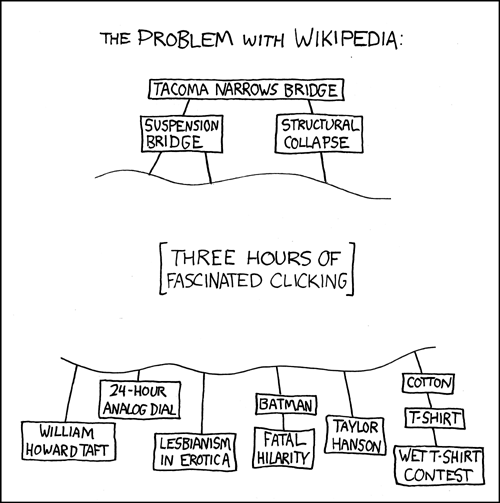
Image 1: The Problem with Wikipedia (XKCD) demonstrating the unexpected destinations Wikis can lead one to
As TV Tropes
grants definition to all things, nothing is bereft of meaning; this is not to
say however that all ideas are granted equal attention.
On the contrary, in a website where everything is granted attention, attention granted determines the hierarchy of ideas and so shapes the geography of local cyberspace.
On the contrary, in a website where everything is granted attention, attention granted determines the hierarchy of ideas and so shapes the geography of local cyberspace.
To those
that are aware of its existence, TV Tropes possesses a certain notoriety; in my
earlier entry I referred to the idea “TV Tropes Will Ruin Your Life” and explained
one of the primary factors justifying this view.
There is however another cause for this tongue in cheek reputation, and it is rooted in a fashion of behaviour that far predates the internet itself.
In post-revolutionary France there was a marked shift in the lifestyles of the individual and the culture of the country as a whole.
As the authority of the Second Estate was abolished the relaxation of regulations and controls led to a drastic increase in foot traffic and small businesses, in turn leading to the creation of the Parisian arcades designed to cater for the changing needs of urban life.
This compressed environment of fashion and bustle drew a new breed of socialite, called the flâneur (Prouty, 2009).
Wandering aimlessly through the street theatre that surrounded them, alternately adding to the spectacle and blending into anonymity; the basic concept of the flâneur would not be unfamiliar to the more experienced denizens of the internet in general and of TV Tropes in particular.
TV Tropes is a wiki true, but it is not a place of formally presented hard data.
TV Tropes is a wiki stripped of all pretence of the formats true nature and purpose, a forum of crowdsourced information where every page has the express purpose of being engaging and adding to the spectacle of the site as a whole.
When one “Wiki Walks” through TV Tropes this purpose is crucial to understanding the logic of the networks layout, some pages which should be only a single degree of separation from each other (such as an author and their work) are granted no connection at all and conversely, utterly unrelated subjects may cohabit the same page.
Maps can rarely be true to reality, but they are true to their purpose (Wood, 2001, pp. 8).
References
XKCD. The
Problem with Wikipedia. (viewed on the 19th of August)
https://xkcd.com/214/
https://xkcd.com/214/
TV Tropes:
TV Tropes Will Ruin Your Life. Main Page. (Viewed 19th August 2016)
http://tvtropes.org/pmwiki/pmwiki.php/Main/TVTropesWillRuinYourLife
http://tvtropes.org/pmwiki/pmwiki.php/Main/TVTropesWillRuinYourLife
TV Tropes:
Older Than Radio. Main Page. (Viewed 19th August 2016)
http://tvtropes.org/pmwiki/pmwiki.php/Main/OlderThanRadio
http://tvtropes.org/pmwiki/pmwiki.php/Main/OlderThanRadio
Prouty, R.,
2009, A Turtle on a Leash
http://www.onewaystreet.typepad.com/one_way_street/2009/10/a-turtle-on-a-leash.html
http://www.onewaystreet.typepad.com/one_way_street/2009/10/a-turtle-on-a-leash.html
TV Tropes:
The Goals of TV Tropes. Administrivia Page. (Viewed 19th August
2016)
http://tvtropes.org/pmwiki/pmwiki.php/Administrivia/TheGoalsOfTVTropes
http://tvtropes.org/pmwiki/pmwiki.php/Administrivia/TheGoalsOfTVTropes
TV Tropes:
Wiki Walks. Main Page. (Viewed 19th August 2016)
http://tvtropes.org/pmwiki/pmwiki.php/Main/WikiWalk
http://tvtropes.org/pmwiki/pmwiki.php/Main/WikiWalk
Wood, D.,
2001, Seeing Through Maps: Many Ways to See the World, TJ Press International,
pp. 8

No comments:
Post a Comment